


Looking For Something? Search Our Site Here!

They are so common that by age 35, 25% of Caucasian women, 40% of Hispanic women, and 50% of African American women have clinically significant fibroids – in other words, tumors that cause symptoms. These uterine tumors are essentially always benign (not cancer), but they can cause significant fertility problems nonetheless.
Fibroids are important for a variety of reasons, primarily because they can cause symptoms like heavy bleeding and/or cramping with menstrual periods, pelvic pain, and bowel or bladder problems.
Fibroids or leiomyomas can develop on the outside of the uterus, in the wall of the uterus, or inside the uterine cavity. Uterine tumors that develop on the outside, called “subserosal” fibroids, don’t usually affect fertility, although they can certainly cause other symptoms as they enlarge by pushing into the bladder or by compressing the intestine. As a result, subserosal fibroids do not usually need to be removed in women seeking pregnancy unless they are causing symptoms.
Uterine tumors that develop in the cavity, “submucosal” fibroids, have the worst effect on fertility. They can act almost like an IUD, either by preventing a pregnancy from implanting on the uterine wall or by making it less likely that the pregnancy will remain attached to the wall. Therefore, these tumors have to always be removed.
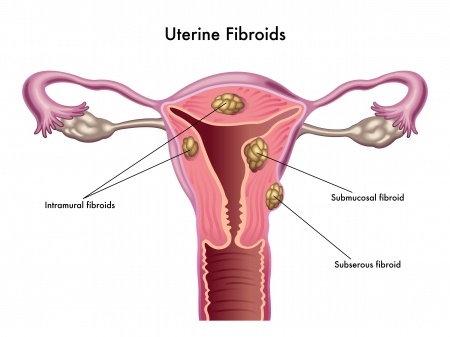 There is a lot of controversy in our field about whether these tumors need to be removed or not. The best data on this subject suggests that intramural fibroids measuring 3 cm or more (slightly more than an inch in diameter) should be removed prior to pregnancy.
Many grow from one location into another – for example, many intramural fibroids are also partially subserosal or submucosal. Their location – in addition to defining their potential effect on fertility – also determines the best surgical approach to remove them.
Submucosal tumors can be removed via hysteroscopy, ie. by passing a surgical telescope through the vagina and cervix into the uterus without making an incision in the patient’s body. Subserosal fibroids and many intramural fibroids can be removed via laparoscopy, ie. by passing a surgical telescope and other surgical instruments through the patient’s belly button into the abdominal cavity.
Patients with very large fibroids, multiple fibroids, or fibroids that grow all the way through the wall into the cavity should usually be removed through a slightly larger abdominal incision, or “laparotomy”. Both hysteroscopy and laparoscopy are outpatient procedures. In other words, patients can go home the same day of surgery and can usually return to work within a couple of days. Patients who require a laparotomy typically spend 1-2 nights in the surgery center or hospital and can usually return to work within one week.
In summary, fibroids (leiomyomas) are a significant problem that we encounter in a lot of our patients. Fortunately, they can be very effectively treated so that they do not need to prevent your pursuit of pregnancy
Find out more about fibroids, contact our Austin fertility specialists today.